

Can a current sensor measure alternating current? This is a question that many engineers, electricians, and hobbyists often ask when dealing with electrical systems. As a current sensor supplier, I'm here to provide a comprehensive answer to this query, exploring the capabilities of current sensors in measuring alternating current (AC) and how our products can meet your specific needs.
Understanding Alternating Current
Before delving into the ability of current sensors to measure AC, it's essential to understand what alternating current is. Alternating current is an electric current that periodically reverses direction. Unlike direct current (DC), which flows in only one direction, AC changes its magnitude and direction in a sinusoidal pattern. This characteristic makes AC the preferred choice for power transmission over long distances, as it can be easily transformed to different voltage levels using transformers.
Types of Current Sensors
There are several types of current sensors available in the market, each with its own working principle and suitability for measuring different types of currents. The most common types include:
- Hall - effect sensors: These sensors use the Hall effect, a phenomenon where a voltage difference is created across an electrical conductor when a magnetic field is applied perpendicular to the current flow. Hall - effect sensors can measure both DC and AC currents. They are non - intrusive, meaning they can measure current without breaking the circuit, and are widely used in applications such as motor control, power monitoring, and renewable energy systems.
- Current transformers (CTs): CTs are designed specifically for measuring AC currents. They work on the principle of electromagnetic induction. A CT consists of a primary winding, which is connected in series with the circuit carrying the current to be measured, and a secondary winding. The magnetic field generated by the primary current induces a current in the secondary winding, which is proportional to the primary current. CTs are commonly used in high - voltage power systems for metering and protection purposes.
- Rogowski coils: These are flexible, air - cored coils that can be wrapped around a conductor to measure AC current. They operate based on Faraday's law of electromagnetic induction. Rogowski coils are non - invasive, lightweight, and can be easily installed in tight spaces. They are often used in applications where temporary or portable current measurements are required, such as in electrical testing and troubleshooting.
Measuring Alternating Current with Current Sensors
So, can a current sensor measure alternating current? The answer is yes, but the suitability of a particular sensor depends on several factors, including the frequency range, accuracy requirements, and the magnitude of the current to be measured.

- Frequency range: Different current sensors have different frequency response characteristics. For example, Hall - effect sensors can typically measure AC currents with frequencies ranging from a few hertz to several kilohertz. Current transformers are generally designed for power - frequency applications (50 or 60 Hz), although some high - frequency CTs can measure currents at frequencies up to several hundred kilohertz. Rogowski coils can measure a wide range of frequencies, from a few hertz to several megahertz, making them suitable for measuring high - frequency AC currents.
- Accuracy requirements: The accuracy of a current sensor is crucial, especially in applications where precise current measurements are required. Hall - effect sensors can provide high accuracy, typically within a few percent of the measured value. Current transformers can achieve even higher accuracy, with errors as low as 0.1% or less. However, the accuracy of a CT can be affected by factors such as the burden resistance, the load current, and the temperature. Rogowski coils generally have lower accuracy compared to Hall - effect sensors and CTs, but they can still provide sufficient accuracy for many applications.
- Current magnitude: The magnitude of the current to be measured also plays a role in selecting the appropriate current sensor. Hall - effect sensors can measure currents ranging from a few milliamperes to several thousand amperes. Current transformers are available in a wide range of current ratings, from a few amperes to tens of thousands of amperes. Rogowski coils can measure currents from a few amperes to very high currents, making them suitable for measuring large - scale industrial currents.
Our Current Sensor Products for AC Measurement
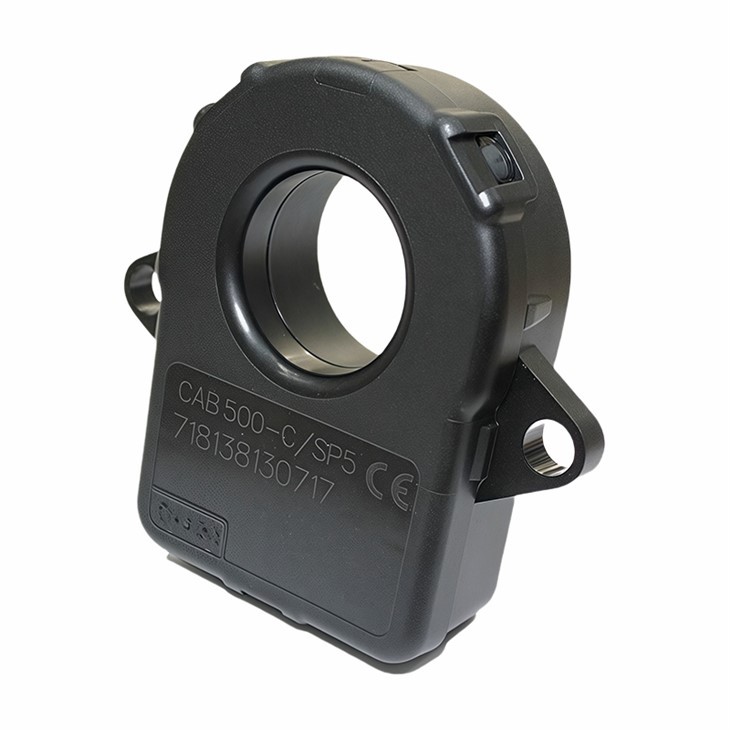
As a current sensor supplier, we offer a wide range of products that are suitable for measuring alternating current. One of our popular products is the LEM CAB500C 12V CAB500 Current Sensor. This Hall - effect current sensor is designed to measure DC and AC currents up to 500 A. It offers high accuracy, fast response time, and excellent linearity. The sensor is easy to install and can be used in a variety of applications, including battery management systems, solar inverters, and motor drives.
In addition to the LEM CAB500C, we also offer a range of current transformers and Rogowski coils. Our CTs are available in different current ratings and accuracy classes, and are suitable for use in power distribution systems, industrial automation, and electrical metering. Our Rogowski coils are flexible, lightweight, and can be used for both permanent and temporary current measurements in a wide range of applications.
Benefits of Using Our Current Sensors for AC Measurement
- High - quality products: Our current sensors are manufactured using high - quality materials and advanced manufacturing processes, ensuring reliable and accurate performance.
- Technical support: Our team of experienced engineers can provide technical support and assistance to help you select the right current sensor for your application. We can also offer customization services to meet your specific requirements.
- Competitive pricing: We offer our current sensors at competitive prices, providing you with cost - effective solutions for your current measurement needs.
Contact Us for Your Current Sensor Needs
If you are looking for a reliable current sensor to measure alternating current, we are here to help. Whether you need a Hall - effect sensor, a current transformer, or a Rogowski coil, we have the products and expertise to meet your requirements. Contact us today to discuss your specific needs and get a quote for our current sensor products. We look forward to working with you to provide the best current measurement solutions for your applications.
References
- Dorf, R. C., & Bishop, R. H. (2011). Electric Circuits. Wiley.
- Grover, F. W. (1946). Inductance Calculations: Working Formulas and Tables. Dover Publications.
- Helfrick, A. D., & Cooper, W. D. (1990). Modern Electronic Instrumentation and Measurement Techniques. Prentice Hall.