

Hey there, folks! As a current sensor supplier, I often get asked if current sensors can be used in industrial automation. Well, the short answer is a resounding yes! In this blog, I'll dive into the nitty - gritty of how current sensors play a crucial role in industrial automation.
First off, let's understand what industrial automation is all about. Industrial automation involves using control systems, such as computers or robots, and information technologies for handling different processes and machineries in an industry. The goal is to replace human labor, increase efficiency, reduce errors, and improve overall productivity. And current sensors are like the unsung heroes in this scenario.
One of the primary functions of a current sensor in industrial automation is monitoring. In industrial settings, there are numerous electrical devices and machines that consume power. By using a current sensor, we can monitor the current flowing through these devices. For example, in a manufacturing plant, large motors are used to drive conveyor belts, operate machinery, and perform other essential tasks. A current sensor can continuously measure the current drawn by these motors. If there is an abnormal increase in current, it could indicate a problem like a mechanical jam in the motor, a short - circuit, or worn - out components. Early detection of such issues can prevent costly breakdowns and production losses.
Another important aspect is power management. In an industrial facility, managing power consumption is crucial for both cost - savings and environmental reasons. Current sensors help in accurately measuring the power consumption of different equipment. This data can be used to optimize the operation of machines. For instance, if a particular machine is consuming more power than necessary, adjustments can be made to its settings or maintenance can be scheduled to improve its efficiency.
Now, let's talk about the types of current sensors that are commonly used in industrial automation. There are several types, including Hall - effect sensors, shunt resistors, and Rogowski coils. Hall - effect sensors are very popular because they can measure both DC and AC currents without direct contact with the conductor. They work based on the Hall effect, where a voltage is generated perpendicular to the current flow when a magnetic field is applied. This makes them ideal for applications where isolation is required, such as in high - voltage systems.
Shunt resistors, on the other hand, are simple and cost - effective. They work by measuring the voltage drop across a known resistance. The current can then be calculated using Ohm's law (I = V/R). Shunt resistors are often used in low - voltage and high - current applications.

Rogowski coils are flexible and can be easily wrapped around a conductor. They are mainly used for measuring AC currents, especially in large - scale industrial applications where high - accuracy current measurements are required.
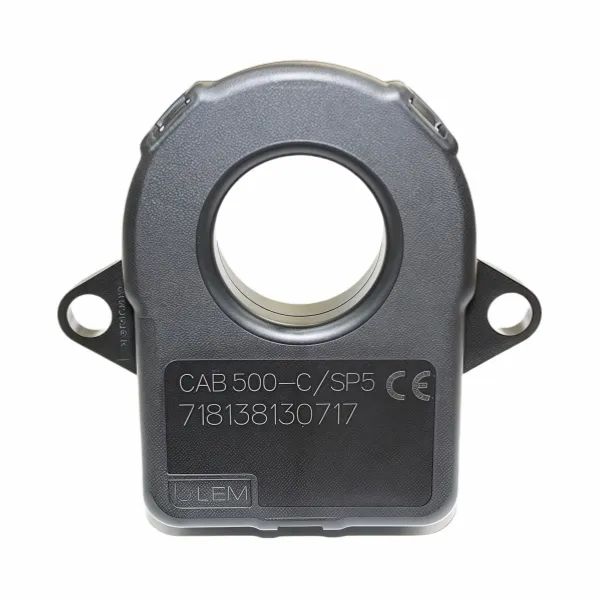
One of our popular products, the LEM CAB500C 12V CAB500 Current Sensor, is a great example of a current sensor suitable for industrial automation. It offers high accuracy and reliability, making it perfect for monitoring and controlling the current in various industrial equipment.
In addition to monitoring and power management, current sensors are also used in control systems. In industrial automation, feedback control is often used to ensure that machines operate within desired parameters. Current sensors can provide the necessary feedback to the control system. For example, in a motor control system, the current sensor can measure the current drawn by the motor. Based on this measurement, the control system can adjust the voltage or frequency supplied to the motor to maintain a constant speed or torque.
Safety is also a major concern in industrial automation. Current sensors can play a vital role in ensuring the safety of workers and equipment. For example, in a circuit breaker system, a current sensor can detect over - current conditions. When an over - current is detected, the circuit breaker can be tripped to cut off the power supply, preventing damage to the equipment and reducing the risk of electrical fires.
However, there are some challenges when using current sensors in industrial automation. One of the main challenges is electromagnetic interference (EMI). In an industrial environment, there are many sources of EMI, such as motors, generators, and power lines. This interference can affect the accuracy of the current sensor measurements. To overcome this, current sensors are often designed with shielding and filtering techniques to reduce the impact of EMI.
Another challenge is the need for calibration. Over time, the performance of current sensors can degrade, leading to inaccurate measurements. Regular calibration is required to ensure that the sensors are providing reliable data.
In conclusion, current sensors are an essential component in industrial automation. They offer a wide range of benefits, including monitoring, power management, control, and safety. Whether you're running a small manufacturing unit or a large - scale industrial complex, current sensors can help you improve efficiency, reduce costs, and ensure the smooth operation of your equipment.
If you're interested in learning more about our current sensors or are looking to purchase them for your industrial automation needs, don't hesitate to reach out. We're here to help you find the right solution for your specific requirements. Let's start a conversation and see how we can work together to take your industrial automation to the next level.
References
- Industrial Automation Handbook
- Electrical Engineering Textbooks on Power Systems and Sensors