

What is the accuracy of a current sensor? Well, let me break it down for you. As a current sensor supplier, I've dealt with all sorts of questions about these nifty little devices, and accuracy is definitely one of the most common ones.
First off, what exactly is a current sensor? It's a device that measures the current flowing through a conductor. Sounds simple, right? But the accuracy of how it does that can vary quite a bit. Accuracy in a current sensor refers to how close the measured value is to the actual current value. It's usually expressed as a percentage of the measured value or in parts per million (ppm).

Let's say you have a current sensor with an accuracy of ±1%. That means if the actual current flowing through the conductor is 100 amps, the sensor's measurement could be anywhere between 99 amps and 101 amps. That might not seem like a big deal in some applications, but in others, like in high - precision industrial control systems or sensitive electrical circuits, even a small deviation can cause big problems.
There are several factors that can affect the accuracy of a current sensor. One of the major ones is the sensor's design. Different types of current sensors, such as Hall - effect sensors, shunt resistors, and current transformers, have different levels of accuracy. Hall - effect sensors, for example, are known for their non - contact measurement, which can be really useful in many applications. They work by detecting the magnetic field generated by the current. However, their accuracy can be affected by factors like temperature, magnetic interference, and the linearity of the Hall element.
Shunt resistors, on the other hand, are pretty straightforward. They measure the voltage drop across a resistor to calculate the current. They're often used in low - voltage and low - current applications. But they have their limitations too. The resistance value of the shunt resistor can change with temperature, which can impact the accuracy of the measurement.
Current transformers are commonly used in high - voltage and high - current applications. They work on the principle of electromagnetic induction. But they need to be carefully designed and calibrated to ensure accurate measurements, especially when dealing with different frequencies and waveforms.
Another factor that affects accuracy is the quality of the components used in the sensor. High - quality components generally lead to more accurate sensors. For instance, using a high - precision resistor in a shunt - based current sensor can improve its accuracy. Also, proper calibration during the manufacturing process is crucial. A well - calibrated sensor will give more reliable and accurate readings.
Now, let's talk about some real - world applications and how accuracy matters. In the automotive industry, current sensors are used in electric vehicles (EVs) to monitor the battery current. Accurate current measurement is essential for battery management systems. If the sensor gives inaccurate readings, it could lead to incorrect estimates of the battery's state of charge, which can affect the vehicle's performance and range.
In renewable energy systems, like solar and wind power plants, current sensors are used to measure the power output. Accurate current measurement helps in optimizing the power generation and ensuring the efficient operation of the system.
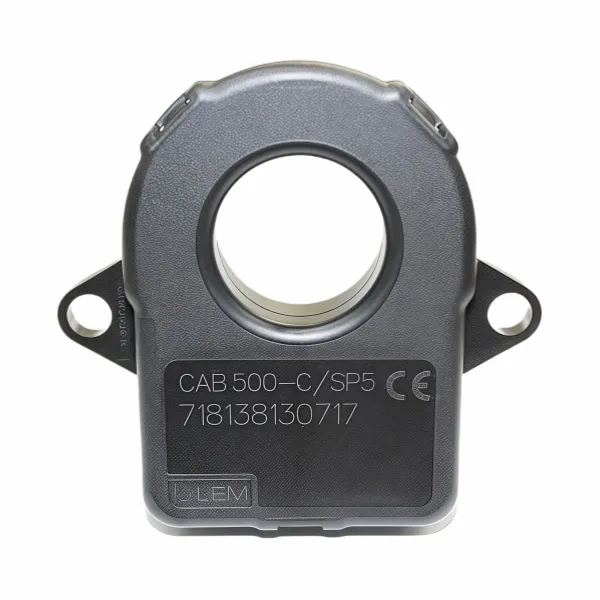
As a current sensor supplier, I offer a wide range of current sensors with different levels of accuracy to meet the needs of various applications. One of our popular products is the LEM CAB500C 12V CAB500 Current Sensor. This sensor is known for its high accuracy and reliability. It's designed to work in a variety of environments and can provide precise current measurements.
If you're in the market for a current sensor, you need to consider your specific requirements. Think about the range of currents you need to measure, the level of accuracy you require, and the environmental conditions in which the sensor will be used. For some applications, a lower - accuracy sensor might be sufficient, while for others, you'll need a high - precision one.
When choosing a current sensor, don't just focus on the accuracy specification. Also, look at other features like the sensor's response time, linearity, and temperature range. A sensor with a fast response time can quickly detect changes in the current, which is important in dynamic applications. Good linearity ensures that the sensor's output is proportional to the input current over a wide range. And a wide temperature range means the sensor can work in different environmental conditions without significant loss of accuracy.
In conclusion, the accuracy of a current sensor is a crucial factor that can impact the performance of many electrical and electronic systems. As a supplier, I'm here to help you find the right current sensor for your needs. Whether you're working on a small DIY project or a large - scale industrial application, I can provide you with the expertise and products to ensure accurate current measurement.
If you're interested in learning more about our current sensors or have specific requirements for your project, don't hesitate to reach out. We can have a detailed discussion about your needs and find the best solution for you. Let's work together to make your electrical systems more efficient and reliable.
References:
- "Current Sensors: Fundamentals, Technologies, and Applications" by various authors.
- Industry whitepapers on current sensor technology and accuracy.